We’re in the final stages of planning our climb that begins one week from today. I’m excited, anxious, and nervous. I’m fairly confident in my fitness at this point because several people that I’ve talked to (including our guides on Mt. Meru) have said that Mt. Meru is a more difficult climb, but Kilimanjaro is just longer and at really high altitude. I’ve also been doing lots of jumping, squats, burpees, stairs, and lots of time on the treadmill at high incline. It’s the altitude that has me worried, but I figure I can’t control my reaction to it, so I’m trying to not spend too much time worrying about that. There is a drug that is used to assist with acclimatization called Diamox, but it’s a sulfa based drug and I’m allergic to sulfa, so that one is out for me. I know others in our group of 6 women are debating whether or not to take it themselves. I also can’t control the weather, so I’ll do my best to stay warm, but that’s all I can control. As you can imagine reaching the summit of the highest peak in Africa and the largest freestanding mountain in the world is the goal, but you can see the last two days (descent) are no joke either with each day hiking almost 17 miles.
There are 6 main routes up Kilimanjaro and we are doing the Marangu Route. The primary reason for choosing this route is that it is the only route that has huts instead of tented camping. And, yes, we will have guides, cooks, and porters supporting us the entire way.
Of course, I created a spreadsheet to get a visual of what each day would look like. Each book/website that I looked at listed different times and distances, so this is more of a rough estimate than anything else, but it still has me intimidated.

Anyone happen to read Mets’ pitcher, R.A. Dickey’s blog in the NY Times about his climb of Kili last week? He climbed with Rockies’ pitcher David Slowey and Met’s catcher Dave Racaniello. They climbed a different route, but it’s a reality check that even professional athletes were not immune to the effects of altitude (spoiler….they all made it).
I like the succinct summary of the climb below. It’s mostly taken from another outfitter’s website.
Day 1 (Mon 1/23): Marangu Gate (1980m) - Mandara hut (2700m)
Hiking time: 5h
Distance: ~12kms
Habitat: Montane forest
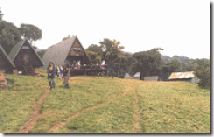
The drive from Arusha to the Kilimanjaro National Park gate probably will take just over a couple of hours. The journey passes through the village of Marangu, which is located on the lower slopes of the mountain. At the park gate, we will sign in at the Park office and make final preparations for the climb. Porters will be seen arranging and loading their packs, containing the food, water, cooking gas as well as most of your equipment. We will carry our daypack items. Leave the Park gate and ascend on a cleared ridge trail through the rain forest. The forest, suffused with mist and dripping with beards of moss, is also where most of Kilimanjaro's animals are found. The first night stop, Mandara hut, is a group of wooden A-framed huts in a forest clearing. Each hut features 6-8 sleeping bunks with solar generated lighting. The total capacity of the camp is 60 climbers. Water is piped into the camp from springs above and there are flush toilets behind the main hut.
Day 2 (Tues 1/24): Mandara hut (2700m) - Horombo hut (3720m)
Hiking time: 6h
Distance: Approximately 15kms
Habitat: Moorland

From Mandara hut the trail passes through a short stretch of forest, then skirts the base of the Maundi Crater and then emerges into the transition from rain forest to moorland. It is well worth a short detour to scramble up the rim of the Maundi Crater for your first really impressive view of the Kibo Crater. On a clear day, Kibo will glimmer in the distance, showing off her majestic glaciers in the morning sun. Once you are in the open moorland you will get the chance to see some of Kilimanjaro's most spectacular plants - the endemic giant lobelia which grows up to 3 m in height and the giant groundsel (Senecia Kilimanjari), which can reach heights of 5m! After about 6 hours from here you reach the Horombo hut, where you will have hot washing water, rest; an evening meal and overnight.
Day 3 (Wed 1/25): Horombo hut (3720m) - Acclimatization day

Horombo hut is a village of huts perched on a small plateau, with buildings similar to Mandara, but with a total capacity of 120 climbers! Horombo is normally bustling with hikers, guides and porters, with an atmosphere of adventure and excitement. You will meet both ascending and descending hikers here. This extra day and night at Horombo is for additional acclimatization. A hike towards the Mawenzi hut, passing the Zebra Rocks on the way (about 3 hours up and 1.5 hours down) is strongly recommended. This hike will further assist with the process of acclimatization.
Day 4 (Thurs 1/26) Horombo hut (3720m) - Kibo hut (4700m)
Hiking time: 6h
Distance: Approximately 15kms
Habitat: Alpine desert
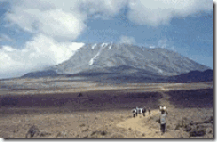 After breakfast you now continue your ascent into the Alpine desert habitat. From Horombo there are two trails to the "Saddle" (which refers to the area located between the peaks of Mawenzi and Kibo). There is an upper route (right hand fork) and lower route (left hand fork) to choose from. The upper route (right hand fork) will be very familiar, as you will have climbed most of it the previous day towards Mawenzi hut. It is very stony and eroded. The recommended lower route (left hand fork) is much easier and nearly an hour shorter, and it also passes the last watering point at 4130m. You will have to fill your water bottles with all the water you will need until your return to Horombo hut in two night's time. Once again remember to slow down and drink enough water!!
 Situated in the barren Alpine desert is Horombo hut, a stone build block house which has bunk beds for 60 climbers, but no streams with water nearby. It is however possible to buy mineral water and soft drinks at the camp office. There are platform toilets behind the hut. The summit is now a further 1195m up and you will make your final ascent the same night. To prevent freezing it will be wise to carry your water in a thermal flask. Go to bed at round about 19h00 and try to get as much rest and sleep as possible.
Day 5 (Fri 1/27…if all goes well we’ll be summiting around sunrise Friday morning while the US folks are just going to bed on Thursday night): (Summit Attempt) Kibo hut (4700m) - Uhuru Peak (5895m) - Horombo hut (3720m)
Hiking time: 8h to Uhuru, 6h to get to Horombo
Distance: Approximately 6kms ascent, 21kms descent
Habitat: Stone scree and ice-capped summit
 You will rise around 23h30, and after some tea and biscuits you shuffle off into the night, and this is where the going really gets tough. The first section of the trail consists of a rocky path to the Hans Meyer Cave (5150m), also a good resting spot. The path then zigzags up to Gillman's point (5 681m), which is located on the crater rim. This section is very steep with a lot of stone scree, requiring a great physical and mental effort. This is probably the most demanding section of the entire route. Do the Kili shuffle and move slowly.
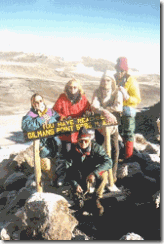 From Gillmans Point you will normally encounter snow all the way up to Uhuru peak (5895m), the highest point in Africa. Total exhilaration and satisfaction - you made it. Weather conditions on the summit will determine how long you will be able to spend, taking photographs, before the 3 hour descent back to Kibo hut. After a short rest you gather all your gear you left behind for the ascent and head down to Horombo hut (3 hours) for your overnight. The return to Horombo hut will seem surprisingly fast compared to the ascent. The total time spent walking on this day is around 14 hours, so be prepared for a very tough day. Later in the evening you enjoy your last dinner (with soft drinks and beer for sale at the camp office) on the mountain and a well-earned sleep, filled with memories and stirring emotions.
Day 6 (Sat 1/28…Happy 4th Birthday to Anderson): Horombo hut (3720m) - Marangu Gate (1980m) and back home.
Hiking time: 6h
Distance: Approximately 27kms
 After breakfast you continue your descent (6 hours), passing the Mandara hut, down to the Marangu gate. At Marangu gate you sign your name and details in a register. This is also where successful climbers receive their summit certificates. Those climbers who reached Gillman's Point (5685m) are issued with green certificates and those who reached Uhuru Peak (5895m), receive gold certificates.
Wish us luck!